How Can Property Management in Kuwait Evolve? From Manual Follow-up to More Organized Management
A practical guide to organizing contracts, collection, maintenance, and reporting — and connecting property-management operations within a single system.
 Written by Marouane Ourahou · July 2, 2026 · 7 min read
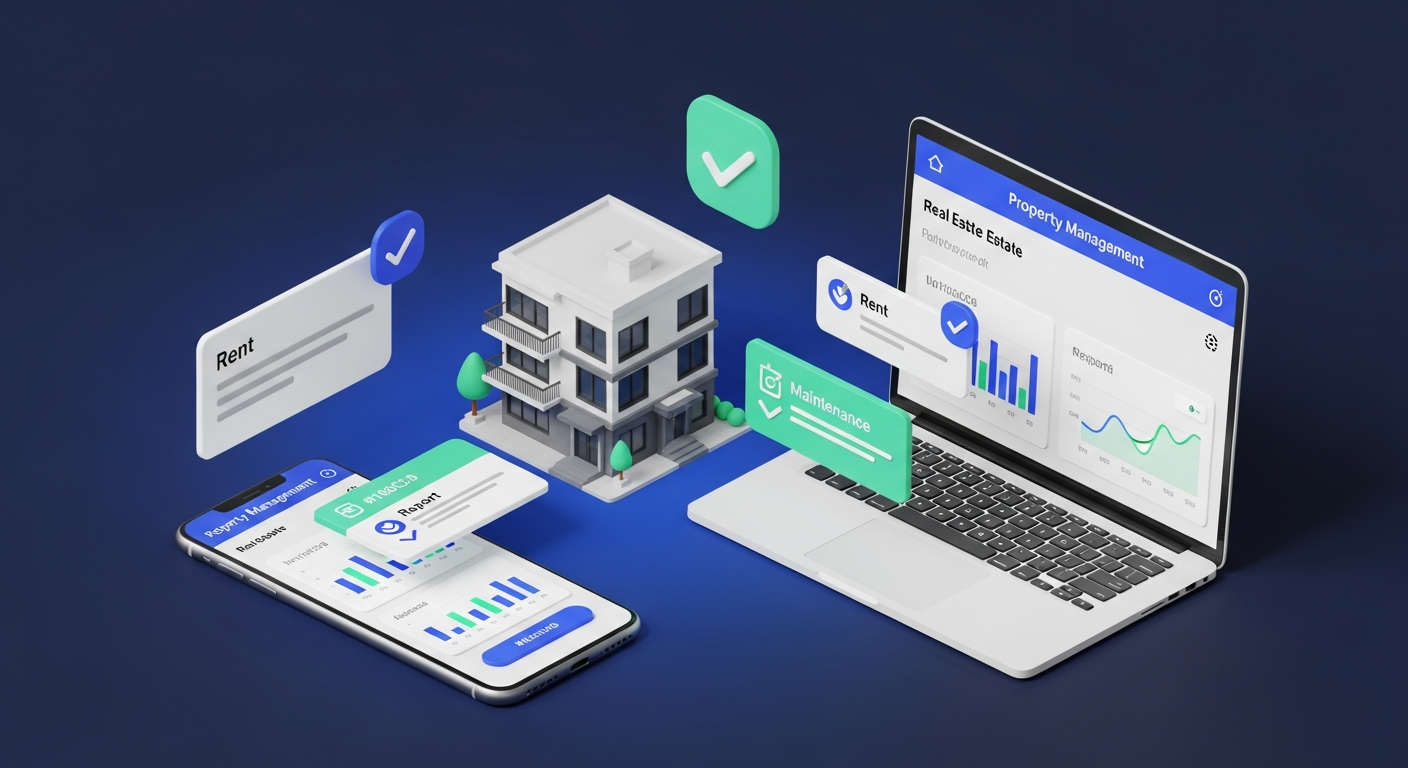
Property management in Kuwait is undergoing a clear change as portfolios grow and digital tools evolve. As the number of units and tenants rises, keeping up with daily details becomes more complex — especially when the data is scattered across WhatsApp, Excel, files, and bank accounts.
Managing a property today isn’t limited to following up on rent. There are contracts that need follow-up, payments that must be recorded and matched, maintenance requests that need tracking, documents that must be saved, and reports that the owner or management team needs to make decisions.
That’s why there is a greater need for a way of working that brings these operations together and connects their data, instead of managing each task separately.
In this article, we look at the most important aspects of modern property management in Kuwait, and how they can be organized using the right tools — from contracts and collection to maintenance and reporting.
Managing a property starts with organizing the details
Every property has a set of operations that repeat constantly. It starts with the contract, then the due dates and invoices, then payments and arrears, along with maintenance, expenses, and reports.
When this information is spread across more than one place, follow-up becomes an essential part of the team’s work.
But when the data is connected, information can move from one operation to another without needing to be re-entered or searched for in more than one place.
Example: following up on rent
One of the most repeated operations in property management is following up on rent.
In the manual way, the team needs to know the due date, send the reminder, follow up on the payment, confirm it has arrived, then record it and link it to the correct contract or unit.
As the number of units grows, the steps don’t change — what multiplies is the number of times they must be carried out.
So the solution isn’t always more follow-up, but organizing the collection cycle itself.
What can be improved?
Automatic reminders: reminders are sent according to the due dates, instead of the process depending on a staff member remembering each tenant.
Electronic payment: offering a direct payment method makes moving from the reminder to payment easier for the tenant.
Recording the payment: when the payment is linked to the contract and unit, the team doesn’t need to search for it or enter the same information again.
This way, following up on rent becomes part of an organized cycle, instead of a series of separate tasks.
Contracts and documents in one place
A contract isn’t just a file saved after signing. It’s the source that rent information, due dates, payments, and the contract’s end date are all tied to.
When the contract is saved on a device, in an email, or in a WhatsApp conversation, the team may need to search for it whenever they need a piece of information.
Having contracts and documents within the system itself makes them easier to access and links them to the property, unit, and tenant they belong to.
This matters especially as the portfolio grows and the number of contracts and documents becomes too large to track manually.
Maintenance needs clear follow-up
Maintenance is an essential part of property management, but it differs from collection in one important way. A maintenance request may start with a message from the tenant, then need someone assigned, communication with the technician, recording the cost, and following up on completion.
If these steps stay inside scattered conversations, it becomes hard to know the status of each request.
But when each request has a clear status, an assigned owner, a date, and a cost, it becomes easier to know what has been done and what needs follow-up.
Example: a maintenance request
Suppose a tenant reports a problem with the air conditioning.
Instead of the message staying inside a conversation, the request can be recorded and linked to the unit and tenant, then followed up until it is closed.
This way the management team knows what needs action, and the owner can see the request’s status without needing to go back to more than one source.
Reports are not just numbers
A good report isn’t limited to showing revenue and expenses. What matters more is that it reflects what is actually happening inside the property.
- How much has been collected?
- What is overdue?
- Which units are vacant?
- What are the expenses?
- Which contracts are nearing their end?
- And which properties need follow-up?
When this information is spread across different files, the team needs to gather it before preparing the report.
But when the data comes from the operations themselves, the report becomes a reflection of the daily work, not a separate task that starts at the end of the month.
This is where the importance of connecting financial management to operations appears. Data on payments, expenses, contracts, and units must be linked together so the portfolio’s financial picture is clear.
The problem isn’t the number of tools
A management team might use WhatsApp to communicate, Excel to follow up, the bank account to see payments, an accounting program to record, and separate files for contracts.
Each tool may be useful on its own.
The problem starts when a staff member needs to move information between them.
A payment arrives at the bank, then is searched for in Excel, then recorded in the accounting program, then the contract is updated, then the report is prepared.
In the end it’s one process, but spread across several places.
That’s why improving property management doesn’t necessarily mean adding a new tool for every problem. In many cases, the real improvement is in connecting the operations that already work together.
How can technology organize property management?
Modern property-management platforms make it possible to bring the core operations together within a single system, so the data is connected instead of staying separate.
In Ajar, for example, contract management is connected to collection, invoices, payments, expenses, and reports, so the data from one operation can be used in the operations tied to it.
This means recording a new contract doesn’t stay just a record of a document, but becomes the basis for the due dates, invoices, collection, and follow-up tied to the contract.
Likewise, a payment isn’t just a separate financial transaction, but is linked to the contract, unit, and tenant, and appears within the portfolio’s data.
And this is the core idea behind a connected system: that operations work together, instead of each part working in isolation from the others.
What changes when operations are organized?
When operations become connected, the management team’s role itself changes.
Instead of spending time searching for information, re-entering it, and matching data, the team can focus on the cases that genuinely need intervention and follow-up.
And instead of waiting until the end of the month to know the portfolio’s performance, the data becomes available while the work is happening.
And instead of relying on a staff member’s memory to know what happened, operations become recorded and can be referred back to.
This isn’t just a faster way to get tasks done. It’s a way that makes managing a property clearer, especially as the portfolio grows.
Managing a property as one process
A property doesn’t work in separate parts.
- The contract affects the invoices.
- The invoices are linked to the payments.
- The payments enter the accounts.
- The expenses affect financial performance.
- Maintenance affects the tenant experience and the property’s cost.
- And the data resulting from all of this helps the owner and property manager make decisions.
So the more these operations are connected, the clearer managing the portfolio becomes, and the less it depends on manual follow-up.
This is the role a property-management platform should play: organizing and connecting operations, not just replacing a paper or a file with another digital tool.
Conclusion
Property management in Kuwait is changing as portfolios grow and the operations that owners and management teams need to follow up on increase.
But digital transformation doesn’t just mean using a program instead of Excel or sending a payment link instead of a bank transfer.
The most important step is organizing and connecting operations so the data works together from the start of the contract all the way to collection, maintenance, and reporting.
This is where managing a property shifts from a set of scattered tasks into a clearer, more organized process.
If you manage a property or a portfolio, you can start by looking at how you currently work: Where does follow-up repeat? Where do you re-enter data? And where do you need to search for information before you can make a decision?
These are the points where more organized management begins.
Start your trial with Ajar and discover how your property’s operations can be managed from a single system.
Frequently asked questions
What is property management software?
Property management software helps landlords and property managers streamline operations, including tenant management, rent collection, and maintenance coordination.
How can technology improve tenant communication?
Technology can enhance tenant communication through online portals, automated notifications, and centralized messaging systems.
What are the benefits of automated rent collection?
Automated rent collection ensures timely payments, reduces administrative workload, and enhances tenant satisfaction.
Why is financial reporting important in property management?
Financial reporting provides insights into property performance, helping managers make informed decisions and optimize operations.
What common mistakes should property managers avoid?
Common mistakes include neglecting tenant relationships, poor communication, and failing to address maintenance issues promptly.