How Ajar Customers Reach a 92% Collection Rate: The 90-Day Plan
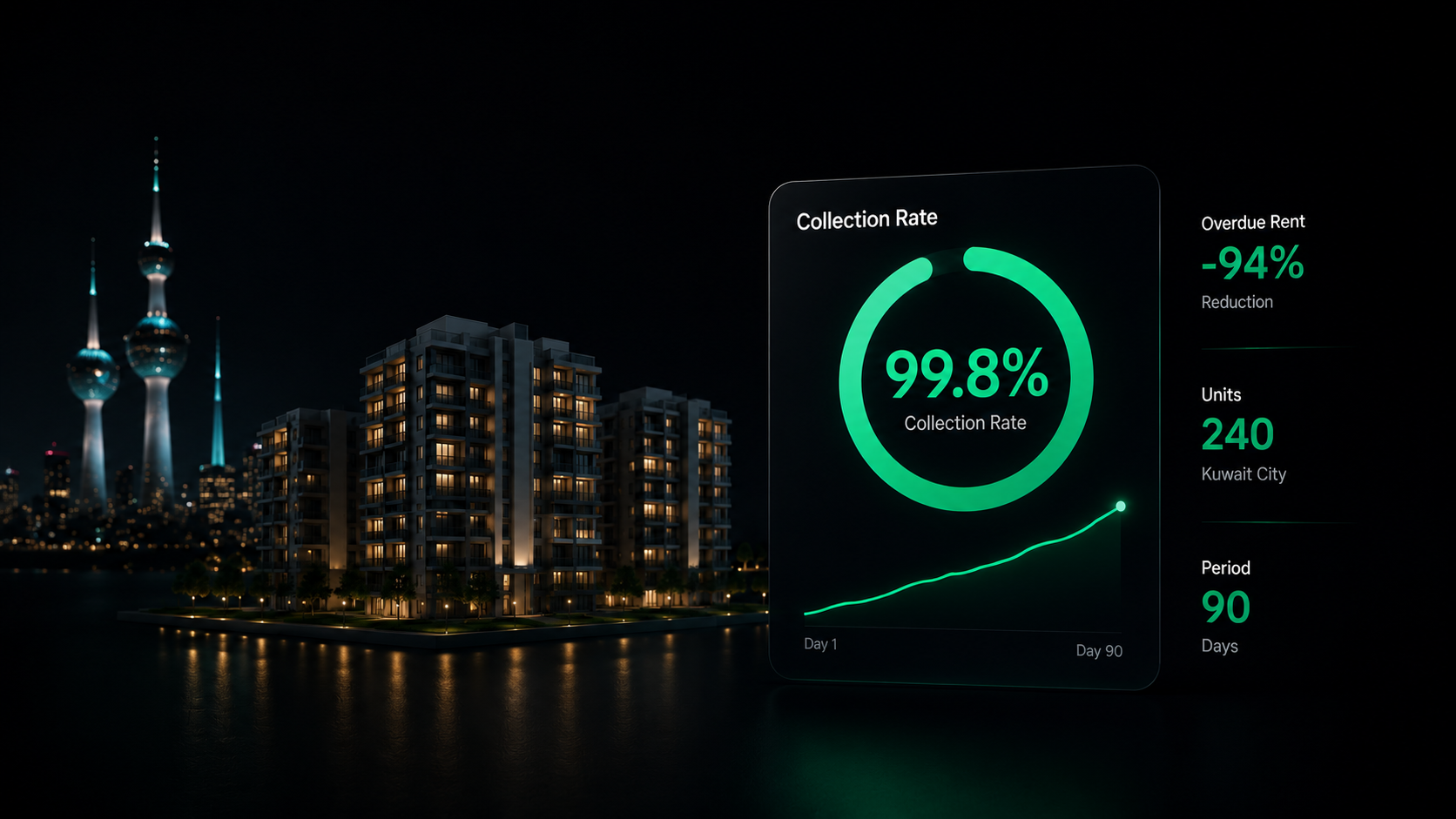
The rent-collection rate for active contracts among Ajar customers is around 92%, according to Ajar's data. Here is how any property portfolio in Kuwait can move to a more organized, automated collection cycle within 90 days.
 Written by Marouane Ourahou · August 8, 2026 · 4 min read
The number first, then the method
The rent-collection rate on due amounts for active contracts among Ajar customers is around 92%. But reaching a high level of collection does not depend only on reminding a tenant when they fall behind — it depends on organizing the entire collection cycle, from the contract and invoice data all the way to payment, documentation, and follow-up.
In this article, we look at how a property portfolio can move, over the first 90 days, from scattered manual follow-up to a more organized and automated collection cycle.
Phase one (days 1 to 30): building the foundation
A higher collection rate begins with organizing the data the collection cycle relies on.
Documenting contracts in the system
Every lease is recorded in Ajar with its core details: the unit, the tenant, the rent amount, and the due date. On the basis of this data, the operations tied to the contract are built — from issuing invoices to following up on payment.
Linking contact details
The tenant’s phone number is recorded within their data in the system, ready to be used in reminders and payment notifications. This way the management team doesn’t need to search again for contact details with every collection cycle.
Issuing invoices automatically
Rent invoices are created based on the contract data and the due-date schedule. Once the portfolio setup is complete, invoices become ready on their dates without needing to be entered manually every month.
Phase two (days 31 to 60): running the collection cycle
After contracts and invoices are organized, the collection cycle begins operating on defined schedules.
Staged reminders
The tenant receives a reminder before the due date, then a reminder on the day itself, and another reminder when payment is late, according to the collection cycle’s settings.
This makes follow-up part of the process itself, instead of depending on a staff member remembering who to contact each month.
Ajar’s data indicates that 67% of tenants pay after the first message.
A payment link inside the message
Every reminder arrives with a direct payment link over KNET, so the tenant pays from the message itself within minutes — no bank transfer, no cash, no reconciliation.
Based on Ajar’s data, the rate of late payments drops by about a quarter (~25%) with digital payment compared to manual payment.
And the success rate of electronic payments through Ajar reaches 99.9%.
Stopping reminders after payment
The moment payment is recorded, the reminders tied to the invoice stop automatically. The management team doesn’t need to track who paid and who didn’t, and a tenant who has paid receives no additional messages.
Phase three (days 61 to 90): focusing on the cases that need follow-up
Once the cycle is running, the management team can focus on the cases that genuinely need intervention, instead of following up with every tenant the same way.
The tenant portal
Through the tenant portal, the tenant can view their invoices, track what they owe, and complete payment directly — which reduces the need to contact the management team for basic information.
Handling recurring cases
As the collection cycle continues, the cases where delays recur or that need extra follow-up become apparent. Here the management team can focus on these specific cases, instead of sending reminders and reviewing every tenant’s status manually.
Documenting payments and delays
Payments, their receipts, and payment dates are saved within the system, linked to the contract, unit, and tenant. When there’s a need to review the record of a payment or a delay, the information is available within a single record instead of searching for it across scattered chats or files.
Why does this method work?
Because it moves a large part of the repetitive work from manual follow-up to an organized cycle that starts with the contract data and ends with recording payment.
Instead of the management team remembering the date of every payment, searching for every tenant’s data, sending the reminder, following up on payment, and then recording the transaction, these steps operate within a single connected cycle.
And this is the difference between managing collection and following up on collection manually.
Today, more than 50,000 property units in Kuwait are managed through Ajar.
Start your own ninety days
Moving to more organized collection does not require changing everything at once.
It starts with arranging contracts and data, then running invoices, reminders, and payment, and after that following up on the cases that need real intervention.
Through these phases, collection shifts from a series of repetitive tasks the management team performs every month into a clear workflow that runs on defined schedules and data.
And here the management team’s role becomes bigger than just tracking payments: it focuses on managing the portfolio, while the system handles the repetitive work that precedes and follows payment.